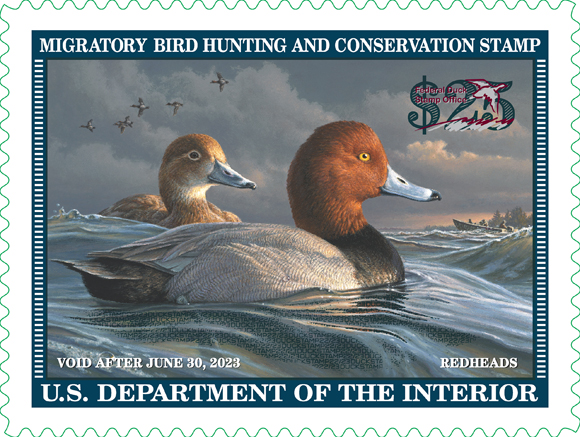
The 2022-2023 Migratory Bird Hunting and Conservation Stamp is now on sale.
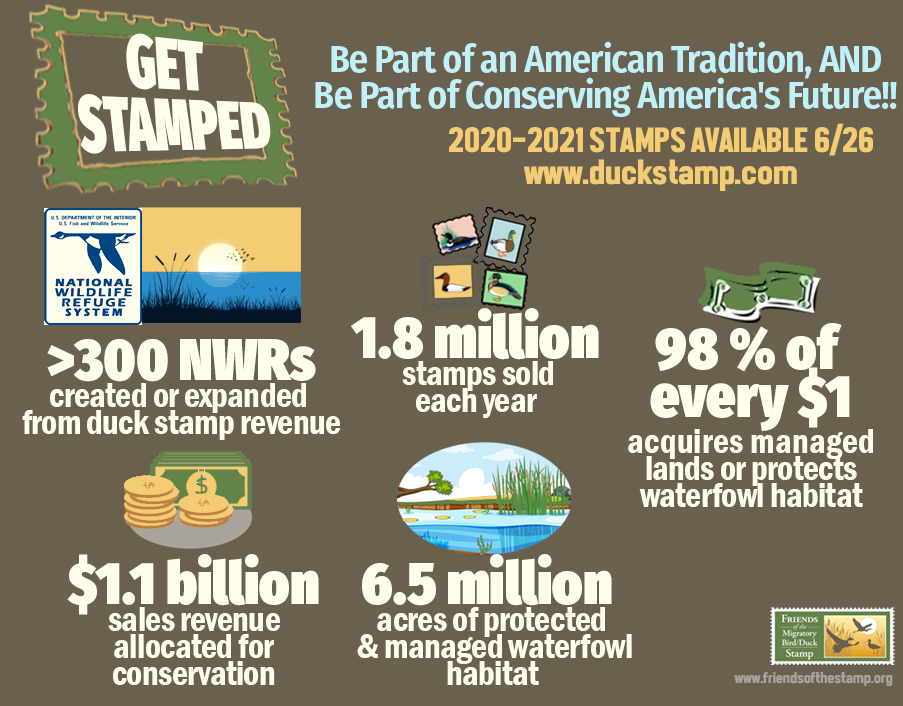
Since 1934, sales of the Stamp have raised over $1.1 billion that has conserved over 6 million acres of wetland habitat for birds and other wildlife. The Stamp sells for $25 and raises approximately $40 million in sales each year.
This year’s Stamp features a pair of Redheads afloat in choppy water. Artist James Hautman of Chaska, Minnesota, has now won the Federal Duck Stamp Art Contest a record-breaking six times.
You can read the press release about this year’s Stamp from U.S. Fish & Wildlife Service.
On August 24, 2021, the U.S. Fish and Wildlife Service published final regulations governing the annual Federal Migratory Bird Hunting and Conservation Stamp Contest. These revisions provide artists more flexibility when designing their art and broaden the appeal of the Duck Stamp to a more diverse audience. They take effect beginning with the 2022 contest.
This final rule removes the “celebrating our waterfowl hunting heritage” theme and the mandatory inclusion of an appropriate hunting element. It changes the judging requirement to consider that the entries reflect this theme. It also revises the qualifications for selection as a judge.
The 2020 final regulations made the hunting theme a permanent requirement, and since then many stakeholders and artists expressed their dissatisfaction with this change.
Waterfowl hunters have been the major contributors to the program. They are required to purchase Duck Stamps to hunt waterfowl. Many collectors, birders and other non-hunters also purchase Duck Stamps to contribute to conservation or for the Stamp’s artistic value. This change will position the contest to engage new artists and more entries by allowing artists more freedom of expression when creating their entries, and to generate increased Stamp revenue through expanded sales to non-hunters.
The live portrayal of one of the eligible species, announced early each year, must be the dominant feature of each entry. Hunting accessories and scenes, such as dogs, decoys and blinds are optional components and can be included at the artist’s discretion.
According to USFWS, “We’re proud that the Duck Stamp continues funding migratory bird and habitat conservation across the U.S., while also bringing together diverse communities through art and a shared connection to wildlife, nature, and a healthy planet.”
Buying a Federal Duck Stamp (Stamp) is one of the most effective ways you can conserve wildlife. Approximately 98% of the $25 Stamp directly funds land acquisition and easements that provide critical habitat for wildlife. These lands are part of the National Wildlife Refuge System and you can access many of them!
At the turn of the 20th century, America’s wildlife was under immediate threats. Market shooting to supply restaurants; bounty hunting and unregulated sport hunting; and feather-collecting for the fashion industry contributed to the loss of millions of birds and other wildlife. Additionally, millions of acres of wetlands were drained for agriculture and development, greatly reducing waterfowl nesting habitat.
By the 1930s, America had entered the Great Depression and many in the Great Plains regions suffered the added economic and ecological effects of the Dust Bowl. During this time President Herbert Hoover signed the Migratory Bird Conservation Act in 1929 to authorize the acquisition and preservation of wetlands as waterfowl habitat. Unfortunately, the law did not provide a permanent funding source to purchase and preserve these wetlands. In 1934, President Franklin D. Roosevelt signed the Migratory Bird Hunting Stamp Act (or “Duck Stamp Act”), which did!
The Duck Stamp Act requires anyone 16 or older to purchase a Stamp for waterfowl hunting. But you don’t have to be a waterfowl hunter to purchase a Federal Duck Stamp! If you care about wildlife and habitats they depend on, help conserve these critical lands by purchasing a Federal Duck Stamp!
Artists and stamp collectors are important stakeholders of the Stamp. In 1949, the first Federal Duck Stamp Art Contest was held. Today, 71 years later, the tradition of hosting a government-sponsored nationwide contest continues. In 1989, Junior Duck Stamp Program was initiated to encourage education and participation for students Kindergarten through 12th-grade nationwide! Junior Duck Stamps are available for purchase for $5.
In addition to serving as a license for waterfowl hunting, benefits for conservation, appeal to collectors and an opportunity for competing artists, the current Federal Duck Stamp also grants you free entrance into any National Wildlife Refuge that charges an entry fee!
Federal Duck Stamps are available online, in post offices, and in many sporting goods and large-scale retail stores that sell hunting and fishing licenses and equipment. Check your local refuge to see if they sell Federal Duck Stamps, as well.
The Migratory Bird Conservation Fund announced that the 2020-2021 Federal and Junior Duck Stamps will be available for purchase on Friday, June 26. These Stamps will feature the winning artwork of Eddie LeRoy of Eufaula, Alabama, and 13-year-old Madison Grimm of South Dakota, winners of the 2020 Federal Duck Stamp Art Contest and 2020 Junior Duck Stamp Contest, respectively. This year’s First Day of Sale ceremony planned for Spanish Fort, AL have been canceled.
Please be a part of this American tradition, and more importantly, be a part in conserving America’s future by purchasing a 2020-2021 Federal Duck Stamp.
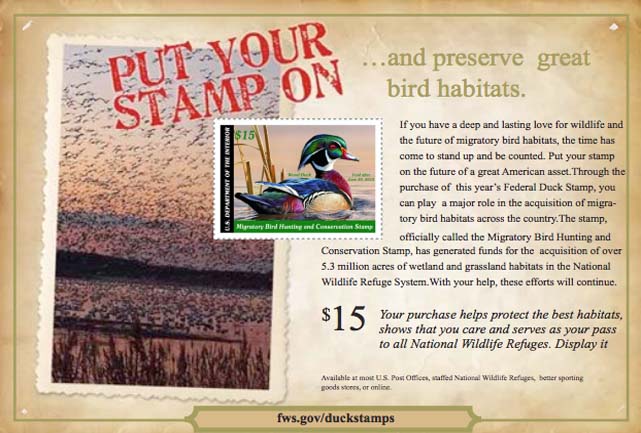
There are many ways to help support the growth and appreciation of the Migratory Bird Hunting and Conservation [Duck] Stamp. The print public service announcement (PSA) for the Stamp shown here is just one way. There are many others we recommend for your consideration.
Don’t just buy the Stamp, display it. Get a stamp in a plastic holder for your personal use, or purchase blank holders in bulk for your organization, club, or group.
See the many materials that are available to help support the Stamp, including posters, the PSAs and a listing of the “top ten reasons” to buy the Stamp.
Write an article in support of the Stamp for your nature/bird/hunting organization, using materials provided here.
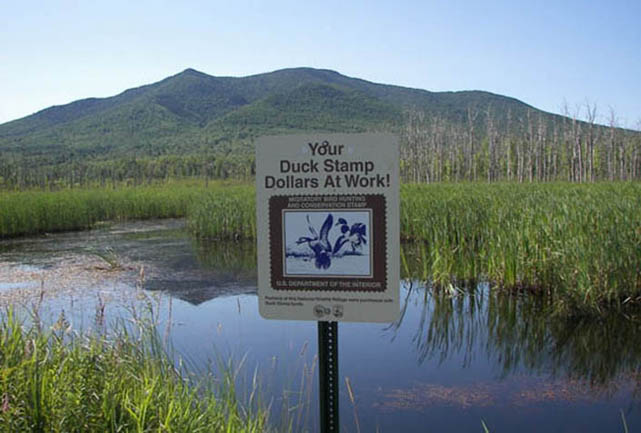
The image above shows a Stamp-associated sign – “Your Duck Stamp Dollars At Work” – at an emergent marsh at the Pondicherry Division of the Silvio O. Conte National Fish and Wildife Refuge in Jefferson, New Hampshire. (You can see Cherry Mountain in the background, part of the White Mountain National Forest.) Almost 30 percent of the Pondicherry Division has been acquired through Migratory Bird Conservation Fund (MBCF) dollars. The MBCF is where Stamp dollars are held prior to investment.
You can access an invaluable listing of every National Wildlife Refuge that has received funding through Stamp dollars here (updated as of April 2016). This involves 252 refuges in the lower 48 states.